

The Cost of Delaying a Business Decision
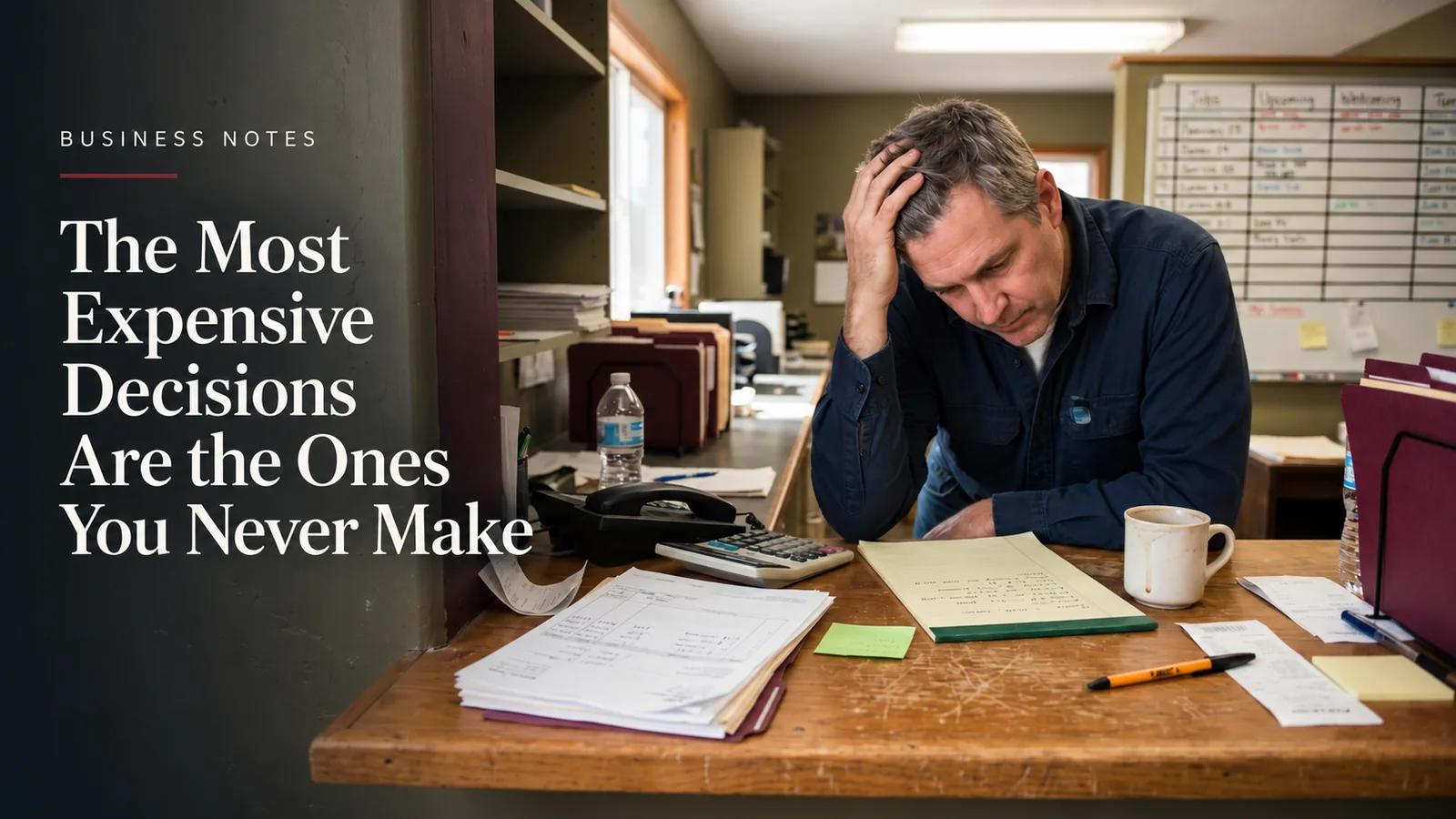
There’s a decision most business owners need to make today, but they won’t — probably telling themselves they can’t…
You probably know the one I mean, because you’ve got at least one of your own. It’s not usually the biggest thing on your desk. It’s the thing that’s been on your desk — your mind — the longest.
You don’t think about it every day. But it shows up — when you’re looking at the numbers and one line doesn’t add up the way you think it should, when an employee says something that reminds you of the conversation you haven’t had, when a customer calls with the same complaint for the third time. It doesn’t really demand your attention. It just sits there, quietly costing you something, while you wait for a better time to deal with it.
Just to be clear about something before we go any further: I don’t think you’re delaying this because you don’t care. Most of the leaders I’ve worked with over the years delay a decision precisely because they care — about an employee, about a customer relationship, about not blowing something up that doesn’t need to be blown up. That instinct isn’t a weakness. It’s often good judgment (but sometimes it is fear). The trouble starts when good judgment turns into doing nothing…
Why good leaders delay
There are real reasons you haven’t made the call yet. You want to be fair to somebody who’s struggling. You think the customer relationship might still turn around. You’re not sure the numbers support spending the money yet. You don’t want to disrupt a team that’s already stretched thin. You’re hoping one more month gives you the clarity you don’t have right now.
None of that is wrong.
A leader who takes those factors seriously is doing the job right, most of the time. The decision is hard precisely because you’re taking it seriously. That’s worth saying plainly, because most advice on this subject starts by assuming you’re lazy or scared. Maybe you are, but that’s not the real problem. The real problem is you’re weighing what’s real against what you don’t know, for sure, yet.
The cost you can see
When you act — when you let someone go, end a customer relationship, raise a price, replace a piece of equipment — the cost shows up immediately and it’s in full color. It’s real. There’s an invoice to pay, a check to write. There’s the revenue you lose when a client walks. There’s the painful conversation you have to have this week, not someday. There’s also the fear that you are making a mistake, and a very real possibility that you are.
Because all those costs are visible, they get weighed heavily. That’s not a flaw in your thinking. It’s being responsible. The problem is that it’s only responsible if the other side of the comparison gets the same attention, and usually it doesn’t.
The cost that’s harder to see
While you wait, the business doesn’t hold still. It keeps moving, and the cost of the unresolved situation gets spread out across a dozen places instead of arriving as one bill. It’s the hour of management attention you keep spending on the same problem instead of moving something else forward. It’s the workaround your team quietly builds so they can keep functioning around the issue you haven’t addressed. It’s the good employee who notices the standard isn’t actually being enforced and adjusts their own effort accordingly. It’s the sale you didn’t make, the margin you gave away, the customer who decided somewhere along the way that you weren’t going to fix it and left for a competitor.
No single piece of that looks big enough to force your hand. That’s exactly why it’s dangerous. Add it up, and it’s often far more expensive than the thing you’re afraid to do.
The cost of an unresolved situation gets spread across the business instead of arriving as one bill
Doing nothing is still making a decision
Here’s the part I want you to think about: waiting isn’t a neutral position. It feels like one, because you haven’t signed anything or said anything hard out loud. It’s the easiest decision by far. But the business doesn’t experience it that way. Every day you don’t act is a day you are effectively choosing to keep the current situation running — to keep absorbing the loss, keep underpricing the job, keep letting the same conflict play out in front of your team.
My number one Rule of Business: Do something — even if it turns out wrong. That doesn’t mean charge in without thinking. It means make the call, see what happens, and adjust from there. You have to keep moving forward, or the business will just go backwards — guaranteed. I’ve probably said this — at one time or another — to every business person I have ever met, so it’s worth a repeat: Doing Nothing Is Going Backwards. Not because standing still is a character flaw, but because your competitors, your costs, your opportunities, and your team’s patience aren’t standing still with you.
How a delayed problem gets more expensive
Left alone, the issue you might be ignoring doesn’t stay the same size. Your team builds routines around it, and now fixing the original problem means unwinding everything that got built to work around it. What used to be unacceptable quietly becomes normal, because it’s been tolerated long enough. Your own credibility takes a hit — people notice when the same issue gets raised over and over with no resolution, and they adjust what they believe your word is actually worth. And your options narrow. A problem you could have corrected cleanly six months ago may now require something far more painful and expensive.
Thoughtful patience, or avoidance?
I don’t want to leave you with the idea that every delay is a failure. Some waiting is exactly right. You’re practicing thoughtful patience if you can name what information you’re still missing, you’ve set a date to revisit it, and you know what might actually change your mind.
You’ve drifted into avoidance if you’re having the same conversation with yourself for the third or fourth or twentieth time with nothing new to show for it, if the deadline keeps moving, if you’re hoping someone else or something external solves it for you, or if honestly, you already know what the answer is and you just don’t want to be the one to carry it out.
Calculate the cost of another 90 days
Pick the one decision that’s been following you around, and ask yourself a few honest questions. What is this costing the business every month, in dollars and in things that don’t show up on the income statement — attention, morale, trust, standards? Who besides you is carrying that cost? What’s genuinely different that you expect to know in 90 days that you don’t know today? And if nothing changes, what will almost certainly be true when that 90 days is up?
Accounting can help you see part of this clearly. But some of the real costs, the energy you spend, the confidence your team has in you, the opportunities quietly passing by, won’t show up as line items, and they’re still real.
Make the next decision
You don’t have to solve the whole thing today. The next right move might be simple: setting the date you’ll decide by, asking the one question you’ve been avoiding, or having the direct conversation you’ve been rehearsing in your head. Moving forward doesn’t have to mean drama.
The most expensive decision in your business right now may not be the one that costs money or comfort today. It might be the one you’re already paying for, every week, because you haven’t made it yet. Name it. Price out another 90 days of waiting. Then decide what you’re going to do next and do it.
